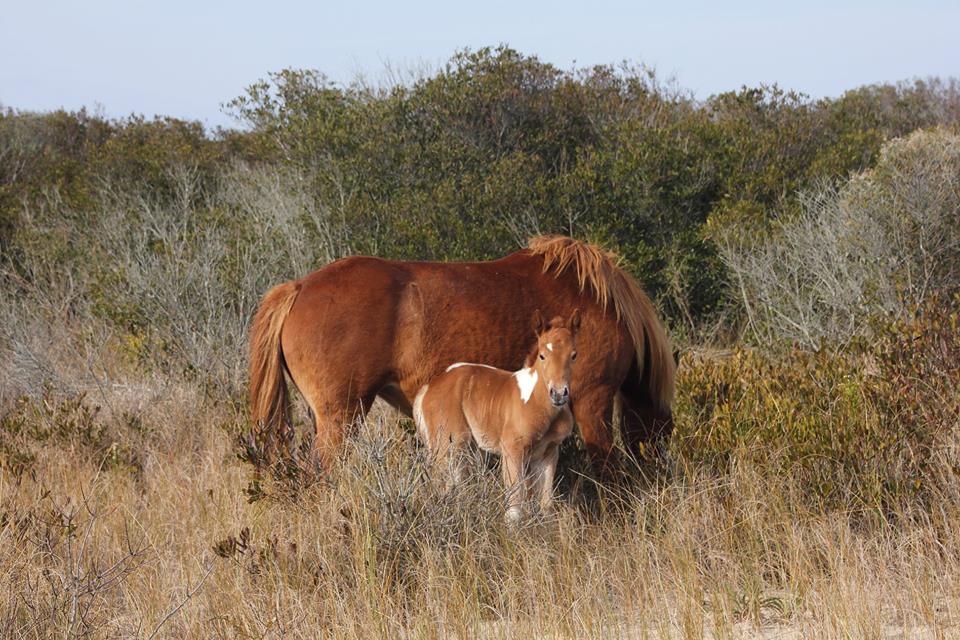
It looks like she has a small triangle of white on her left elbow, also.
Showing posts with label Assateague Island Maryland. Show all posts
Friday, November 23, 2018
New Foal on Assateague in Maryland
While doing their census of ponies on Assateague Island in Maryland a week or so ago, the National park Service discovered a new baby in the stallion Chestnut's band. The dam is Shasta, and the filly's estimated birth date is 16 November - here are a few photos of the dam and foal...
Friday, September 30, 2016
Assorted Photos - Assateague, Italy & People
Charmed finally had her baby - it's a girl!
Actors on the set of Vikings
Fall at the foot of the Dolomites
Tim Tebow's first day as a New York Mets player
Thursday, June 16, 2016
Friday, February 5, 2016
Gifts From Winter Storm Jonas
Winter storm Jonas ripped across the eastern seaboard January 22, 23 and 24. It washed away large sections of the beach (and parking lots) on the southern end of Assateague Island, in Virginia. On the northern end of Assateague, in Maryland, some really interesting sights washed up Pieces of a wooden ship, guessed to be about 200 years old, and some sort of metal hopper. Not to mention sea foam everywhere....
Thursday, September 10, 2015
Photo Odds and Ends
Lynx in Colorado - March 2015
Unusual cloud formation
Seesaw, anyone?
A 45-foot-long boat wreck from the 18th century found under the Nanticoke River Bridge, US 50, Maryland
Brown pelican over Assateague Island waves
Assateague Island (Maryland) sunrise
An egret tree? Assateague Island, Maryland
Wednesday, May 27, 2015
Assateague Island Views
Egret
Pedal bone on beach
Hide on beach
Ribs and pelvis on beach
Trees on Assateague
Assateague
Warbler
Ponies
*** Yes, the bones and hide on the beach are from a pony - not Surfer Dude, but an old mare on the Maryland (northern end) of Assateague ***
Wednesday, July 9, 2014
Ocean City and Assateague Island, Maryland
Assateague Island is an out-rider, a barrier island, that at one time was attached to the state of Delaware, and, possibly, New Jersey in ages past. Assateague, like all barrier islands, has changed in shape over the years. Assateague's shape, length, and over-all form is determined by the movement of sand in the littoral zone - the area between the island and the mainland. In the 1800s, Assateague was connected to Fenwick Island in Delaware, and ran down the east coast to the giant hook of Tom's Cove in Virginia. The island that became Fenwick Island, Delaware, and Rehobeth Beach and Ocean City, Maryland, and also Assateague Island, in both Virginia and Maryland, originally belonged to Native Americans, and was purchased from them by Englishman Thomas Fenwick for trinkets after having been given the patent by Lord Baltimore.
I'm not very aware of the history of the northern end of Assateague, or when it separated from Delaware, but I know about the Maryland and Virginia end of Assateague Island. Anyone who lives beside the sea knows the power of the waves and wind during a storm. Wind, waves, and storms have sculpted Assateague over the centuries. Besides salt marshes and beaches, trees grew upon the island, and there were sources of brackish water, meadows developed and waterfowl and wildlife abounded. Sometime in the 1700s, the people of Chincoteague Island, Virginia began keeping their livestock on Assateague, the island to the east. The main reason was to escape taxation; taxes had to be paid on stock on Chincoteague, but not on Assateague. Cattle, sheep, goats, horses, pigs, and chickens were turned loose to forage on Assateague, and eventually people formed small villages and enclaves on the island. Stock ownership was known by ear notches, and round-ups occurred for sheep-shearing, and market times, as well as to prepare for the winter. The Assateague Lighthouse was built in 1833, at a height of 45 feet, back in 1833; in 1867, it was rebuilt on the original site at a height of 142 feet. When the original light was built, the lighthouse was located in the center of the Virginia part of the island. You can see today, from the top of the lighthouse, how the island has changed form. A village named Assateague formed around the lighthouse, but it was removed to Chincoteague by 1925.
In 1869, Isaac Coffin built the first water-front cottage used for rental in what became Ocean City. The city was declared in 1875, and became incorporated in 1880. There was a small cut,or gut, of water running through Assateague Island near the southern end of the town of Ocean City. People could take shallow-draft boats through the gut at low tide, and those with deeper drafts at high tide. In August 1933, a hurricane brushed up the Delmarva peninsula, and the gut became an inlet. Normally, it would have silted back up, but a system of artificial jetties was built between 1933 and 1935 to preserve the inlet as a navigation channel. This has caused Assateague Island to drift considerably to the west,and now the two islands are more than a half-mile apart. This has benefited Ocean City, creating wider beaches and better fishing access. However, it's caused erosion problems on Assateague.
Between 1933 and the early 1960s, interest alternated between creating a National Seashore on Assateague and pushing for residential and business development on the Maryland end. In 1950, a 15-mile section of the Maryland side of the island, was platted for development and a paved road was built traversing the area. In 1962, the Ash Wednesday storm destroyed the road, Baltimore Boulevard, and many of the private homes were destroyed. Although some private landowners on Assateague supported re-development, Maryland, as a state, supported creation of a National Seashore, and legislation was introduced in the US Congress. Assateague Island National Seashore was created by an Act of Congress in 1965.
One reaches Ocean City, Maryland via US 50.
Assateague Island National Seashore and State Park is accessible by visiting Berlin, Maryland via Maryland State Road 611.
Photos to follow.
I'm not very aware of the history of the northern end of Assateague, or when it separated from Delaware, but I know about the Maryland and Virginia end of Assateague Island. Anyone who lives beside the sea knows the power of the waves and wind during a storm. Wind, waves, and storms have sculpted Assateague over the centuries. Besides salt marshes and beaches, trees grew upon the island, and there were sources of brackish water, meadows developed and waterfowl and wildlife abounded. Sometime in the 1700s, the people of Chincoteague Island, Virginia began keeping their livestock on Assateague, the island to the east. The main reason was to escape taxation; taxes had to be paid on stock on Chincoteague, but not on Assateague. Cattle, sheep, goats, horses, pigs, and chickens were turned loose to forage on Assateague, and eventually people formed small villages and enclaves on the island. Stock ownership was known by ear notches, and round-ups occurred for sheep-shearing, and market times, as well as to prepare for the winter. The Assateague Lighthouse was built in 1833, at a height of 45 feet, back in 1833; in 1867, it was rebuilt on the original site at a height of 142 feet. When the original light was built, the lighthouse was located in the center of the Virginia part of the island. You can see today, from the top of the lighthouse, how the island has changed form. A village named Assateague formed around the lighthouse, but it was removed to Chincoteague by 1925.
In 1869, Isaac Coffin built the first water-front cottage used for rental in what became Ocean City. The city was declared in 1875, and became incorporated in 1880. There was a small cut,or gut, of water running through Assateague Island near the southern end of the town of Ocean City. People could take shallow-draft boats through the gut at low tide, and those with deeper drafts at high tide. In August 1933, a hurricane brushed up the Delmarva peninsula, and the gut became an inlet. Normally, it would have silted back up, but a system of artificial jetties was built between 1933 and 1935 to preserve the inlet as a navigation channel. This has caused Assateague Island to drift considerably to the west,and now the two islands are more than a half-mile apart. This has benefited Ocean City, creating wider beaches and better fishing access. However, it's caused erosion problems on Assateague.
Between 1933 and the early 1960s, interest alternated between creating a National Seashore on Assateague and pushing for residential and business development on the Maryland end. In 1950, a 15-mile section of the Maryland side of the island, was platted for development and a paved road was built traversing the area. In 1962, the Ash Wednesday storm destroyed the road, Baltimore Boulevard, and many of the private homes were destroyed. Although some private landowners on Assateague supported re-development, Maryland, as a state, supported creation of a National Seashore, and legislation was introduced in the US Congress. Assateague Island National Seashore was created by an Act of Congress in 1965.
One reaches Ocean City, Maryland via US 50.
Assateague Island National Seashore and State Park is accessible by visiting Berlin, Maryland via Maryland State Road 611.
Photos to follow.
Friday, August 23, 2013
Scenic Photos
Aurora borealis above Assateague Island, Maryland
Hot air balloon and full moon at Byers Peak, near Winter Park, Colorado
An orchid
Stormy morning at the beach
Trail riding in Lappland, Sweden
Sunday, July 15, 2012
18th Century Assateague Island (MD) House Restored
This story is from the Salisbury Daily Times newspaper, published by Gannett News, Inc, in Salisbury, Maryland. Article and photograph by Brice Stump, Staff Writer for The Daily Times.
ASSATEAGUE -- A brick house that was a landmark here in 1752, then all but forgotten, is destined to become a landmark again, now that the doors are once again open at Rackliffe House.
The house was in ruins when the late Tom Patton had a vision to restore the mid-18th century plantation house in 2004. It was so overgrown, so much in shambles, that even Patton had second thoughts.
"I said to myself, 'This is a damn near impossible job to do,' " he said in a 2010 interview.
Because there were no 18th-century houses in Worcester County open to the public to educate visitors about 18th century life and architecture, Patton believed a rebuilt house with interior woodwork in the style of the period would give resort visitors and students a rare opportunity to step into the past. Mostly importantly, Patton envisioned a interactive media format that would engage youngsters and make their visit here fun, memorable and educational.
He formed the Rackliffe House Trust and, working with a team of volunteers, raised funds to restore and rebuild every aspect of the structure. All of the woodwork was handled by master craftsmen Larry Widgeon and his son, Shawn, who worked with Patton from the project's inception until his death. The Widgeons are still actively involved in the final phase of work, reconstructing and outfitting an early dairy or milk house near the main house.
The million dollar-plus project has saved what Patton described as the only seaside period home remaining in the mid-Atlantic states that's open to the public.
Under Patton's direction, the trust has leased the three-acre site from the Maryland Department of Natural resources for 50 years. The three-acre site is part of 110-acre tract that, in turn, is part of Assateague Island State Park.
Patton died in October 2010, before the official opening of the house last summer. Yet his legacy will remain alive for generations to come as folks tour the house and learn about life on the Shore that once was.
Trust president Joan Jenkins, who was enlisted by Patton just months after he started his project, has seen his vision realized because he was persistent and focused and knew what he wanted to accomplish. Rackliffe is what it is today because of his leadership and perspectives.
"I have worked very hard to do what Tom would have wanted," she said. "Sometimes, when I have a problem, I find myself asking myself 'What would Tom want? What would Tom do?' That's what guides me when I have doubts."
"By early August of last year," said Jim Rapp, director of Rackliffe House Trust, "we had the house open on Thursday afternoons to see how things would go. We put flyers on the Assateague Island Visitor's Center countertop, and we had as high as 40 people coming here. We tested the waters and have just opened now for this season. I think we are close to seeing the reality of Tom's vision of this becoming a coastal heritage center."
Built in about 1752, by Charles Rackliffe, (Patton's ancestor), the two-story and a half story 38-by-32-foot brick house has survived two fires -- the last in 1928 said to have been caused by an exploding still operated by a tenant -- as well as several not-so-sensitive remodelings. It also maintains a long-time reputation for being haunted.
"It could be the ghost of Jack (John) Rackliffe, a pretty mean person, who was supposedly murdered here by his slaves," said Rapp.
"The reconstruction of the milk house marks the end of major work here. Outfitting it and getting it open to the public is all that remains," he said.
Rapp believes the dairy may date to the 1700s, as it was listed on an estate inventory of 1808 as a brick milk house "being in good repair." An estate inventory of 1752 does not list a brick milk house on the property.
"There are a few little things left to do, like the installation of lighting fixtures. We are raising money to outfit the kitchen and the milk house," Jenkins said. "We want to get the kitchen and milk house up and running, but it takes money.
"I want to be here when school groups come in and show the kids our restored dairy (milk house) and tell them this was the refrigerator and the fireplace, with a kettle and crane, was the microwave of 1752," said Jenkins, laughing. "To furnish the milk house, we could use artifacts, churns, milk pans and such, and we do accept donations of items."
"Now that the dairy is almost finished, another thing we have on our wish list is to locate foundations of other buildings that were once here, as well as the graveyard."
"I hope we can get seasonal excavations going again with our archaeologist and board member, Aaron Levinthal," said Rapp. "He said this site is wonderful and rare because it hasn't been disturbed over the years and people just loved seeing an archaeological excavation under way."
According to Jenkins, visitors are surprised to see a period house so close to summer resorts. "We have heard from museum people who have cautioned us against 'filling the place up' with furnishings, to keep the rooms open. We have found people are really interested in the history of the house and stories about the preservation plan. There's a lot of people coming who have never seen an 18th century Eastern Shore house and it is exciting for them."
Though the site is just yards from the neighboring Rum Pointe Golf Course, trees and bushes isolate the house and grounds. Visitors can get a feel for the period and yet be just half a mile from the nearby Assateague Island Visitor's Center, on Route 611, at the base of the Verrazano Bridge leading to Assateague Island.
"The Rackliffe property is open every day, dawn to dusk, and you can walk down Tom Patton Lane and tour the grounds and see the exterior of the house and milk house," Rapp said.
The house is open Thursdays 1-4 p.m., through October. A $2 donation is requested.
Gifts of items to be used in the house or milk house are being accepted. Tax deductible contributions can also be made to the Rackliffe House Trust, PO Box 561, Berlin, Md. 21811. For more information, visit the organization website at www.rackliffehouse.com.
Jim Rapp, director of Rackliffe House Trust, holds before and after photos of the recently restored milk house or dairy. It once served the Rackliffe plantation, near Assateague, in the late 1700s, according to Rapp. / Brice Stump / The Daily Times /
The house was in ruins when the late Tom Patton had a vision to restore the mid-18th century plantation house in 2004. It was so overgrown, so much in shambles, that even Patton had second thoughts.
"I said to myself, 'This is a damn near impossible job to do,' " he said in a 2010 interview.
Because there were no 18th-century houses in Worcester County open to the public to educate visitors about 18th century life and architecture, Patton believed a rebuilt house with interior woodwork in the style of the period would give resort visitors and students a rare opportunity to step into the past. Mostly importantly, Patton envisioned a interactive media format that would engage youngsters and make their visit here fun, memorable and educational.
He formed the Rackliffe House Trust and, working with a team of volunteers, raised funds to restore and rebuild every aspect of the structure. All of the woodwork was handled by master craftsmen Larry Widgeon and his son, Shawn, who worked with Patton from the project's inception until his death. The Widgeons are still actively involved in the final phase of work, reconstructing and outfitting an early dairy or milk house near the main house.
The million dollar-plus project has saved what Patton described as the only seaside period home remaining in the mid-Atlantic states that's open to the public.
Under Patton's direction, the trust has leased the three-acre site from the Maryland Department of Natural resources for 50 years. The three-acre site is part of 110-acre tract that, in turn, is part of Assateague Island State Park.
Patton died in October 2010, before the official opening of the house last summer. Yet his legacy will remain alive for generations to come as folks tour the house and learn about life on the Shore that once was.
Trust president Joan Jenkins, who was enlisted by Patton just months after he started his project, has seen his vision realized because he was persistent and focused and knew what he wanted to accomplish. Rackliffe is what it is today because of his leadership and perspectives.
"I have worked very hard to do what Tom would have wanted," she said. "Sometimes, when I have a problem, I find myself asking myself 'What would Tom want? What would Tom do?' That's what guides me when I have doubts."
"By early August of last year," said Jim Rapp, director of Rackliffe House Trust, "we had the house open on Thursday afternoons to see how things would go. We put flyers on the Assateague Island Visitor's Center countertop, and we had as high as 40 people coming here. We tested the waters and have just opened now for this season. I think we are close to seeing the reality of Tom's vision of this becoming a coastal heritage center."
Built in about 1752, by Charles Rackliffe, (Patton's ancestor), the two-story and a half story 38-by-32-foot brick house has survived two fires -- the last in 1928 said to have been caused by an exploding still operated by a tenant -- as well as several not-so-sensitive remodelings. It also maintains a long-time reputation for being haunted.
"It could be the ghost of Jack (John) Rackliffe, a pretty mean person, who was supposedly murdered here by his slaves," said Rapp.
"The reconstruction of the milk house marks the end of major work here. Outfitting it and getting it open to the public is all that remains," he said.
Rapp believes the dairy may date to the 1700s, as it was listed on an estate inventory of 1808 as a brick milk house "being in good repair." An estate inventory of 1752 does not list a brick milk house on the property.
"There are a few little things left to do, like the installation of lighting fixtures. We are raising money to outfit the kitchen and the milk house," Jenkins said. "We want to get the kitchen and milk house up and running, but it takes money.
"I want to be here when school groups come in and show the kids our restored dairy (milk house) and tell them this was the refrigerator and the fireplace, with a kettle and crane, was the microwave of 1752," said Jenkins, laughing. "To furnish the milk house, we could use artifacts, churns, milk pans and such, and we do accept donations of items."
"Now that the dairy is almost finished, another thing we have on our wish list is to locate foundations of other buildings that were once here, as well as the graveyard."
"I hope we can get seasonal excavations going again with our archaeologist and board member, Aaron Levinthal," said Rapp. "He said this site is wonderful and rare because it hasn't been disturbed over the years and people just loved seeing an archaeological excavation under way."
According to Jenkins, visitors are surprised to see a period house so close to summer resorts. "We have heard from museum people who have cautioned us against 'filling the place up' with furnishings, to keep the rooms open. We have found people are really interested in the history of the house and stories about the preservation plan. There's a lot of people coming who have never seen an 18th century Eastern Shore house and it is exciting for them."
Though the site is just yards from the neighboring Rum Pointe Golf Course, trees and bushes isolate the house and grounds. Visitors can get a feel for the period and yet be just half a mile from the nearby Assateague Island Visitor's Center, on Route 611, at the base of the Verrazano Bridge leading to Assateague Island.
"The Rackliffe property is open every day, dawn to dusk, and you can walk down Tom Patton Lane and tour the grounds and see the exterior of the house and milk house," Rapp said.
The house is open Thursdays 1-4 p.m., through October. A $2 donation is requested.
Gifts of items to be used in the house or milk house are being accepted. Tax deductible contributions can also be made to the Rackliffe House Trust, PO Box 561, Berlin, Md. 21811. For more information, visit the organization website at www.rackliffehouse.com.
Subscribe to:
Posts (Atom)


